
The Play Written 38 Years Ago is as Relevant as it Was Then
In this “era” where a substantial list of movies from the 80s and 90s are being turned into musicals, it is nice to go back to the roots for a play that has gone through all the formats. Real Women Have Curves, by Josefina López, who wrote the piece at the tender age of 18 in the late eighties, was inspired by her own story, which has since morphed into a full-length movie starring America Ferrera in the early 2000s and a Broadway debut in 2025.
This year, the work comes back home to its origin and where it all began at Casa 0101 in Boyle Heights.
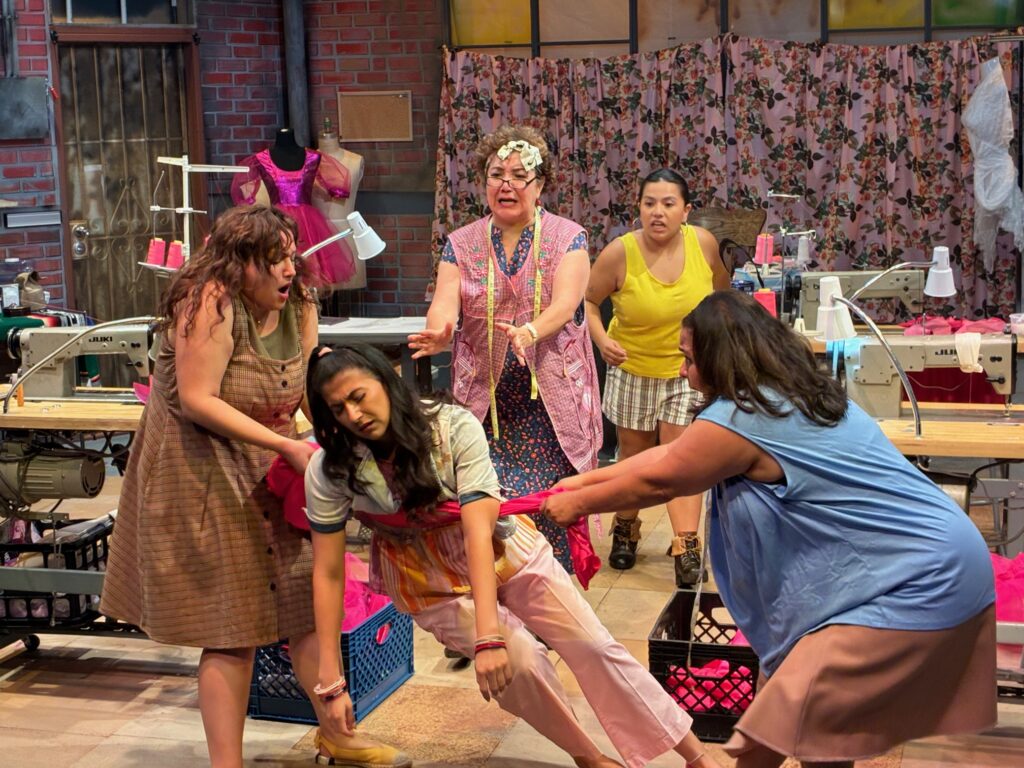
Estela García (Yasha Alanitz) owns a sewing factory in East Los Angeles, where she employs her sister Ana (Stefany Arroyo) and their mother Carmen (Blanca Araceli), along with two more seamstresses, Rosalí (Amy Melendrez) and Pancha (Laura Vega). Ana is an aspiring writer who is taking a year off after graduating high school to help her family and make money for college. She does not want to be at the factory and is very vocal about it. Estela has them working on a contract that is heavy in production but low on pay, since all the women recently received their legal status, except her. Each day at work, the team is vigilant, making sure they do not attract attention and keeping an eye out for the border patrol. The working conditions, the stress, and the heat take their toll, making Estela have a change of heart and plans.
César Rentana-Holguín’s charming set design of the sewing factory with sewing machines, racks, a food station, and dining area, along with a bathroom where secrets are hidden and prayers are whispered, is detailed, colorful, and lively, with Andy James Garcia’s pertinent props that go from sewing accessories to food and clothes. It also feels integrated into the house, as the audience is like an extension of the factory. The sewing machine that Josefina’s mother used in real life is part of the set, which adds more meaning and, now, cool theatre lore.
Corky Dominguez directs the piece, with a trace of three blocks where the actions take place, the eating area on the audience’s left, the sewing in the middle, and the bathroom at the audience’s right, punctually contoured by Alejandro Parra’s lighting, having bright cold lights throughout the set to complement the actions of the work starting and ending, along with soft yellows and ambers in the bathroom highlighting the privacy and intimacy of the space.
The piece has a moving rhythm that flows throughout the 100 minutes, and Dominguez’s direction has each in the cast perform their lines with an organic pace and hilarious comedy. Miguel Angel Delgado’s sound design adequately soundtracks the play with songs ranging from Gloria Trevi to Juan Gabriel, which definitely made the vibe even more engaging.
Stefany Arroyo, as Ana and the narrator, is personable and sassy; Yasha Alanitz, as the leader of the troupe, Estela, conveyed the role of the scared, frustrated, and sensitive entrepreneur well, having both fun and heartfelt scenes. Blanca Araceli, as the matriarch Carmen, was an absolute scene-stealer, delivering utterly funny lines authentically while interacting with the audience and mixing in Spanish in a fitting way. Amy Melendrez’s portrayal of the sweet, reasoning Rosalí added balance to the frame and the comedy while giving food for thought. And, Laura Vega, as Pancha, won over the audience’s heart with her layered interpretation, dosed with uncertainty, flair, and tenderness. Josefina integrated a brief but potent storyline for Pancha that we all grasped and appreciated.
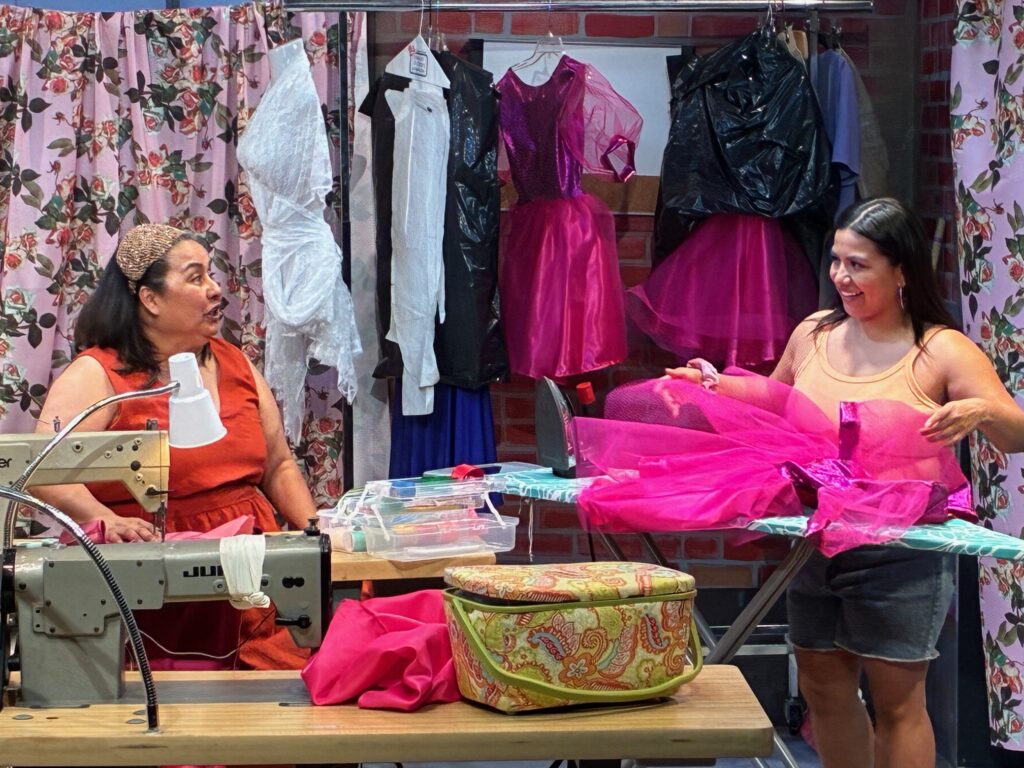
We cannot talk about a sewing factory without a wardrobe, and Tony Iniguez’s design rounded off the story, highlighting each of the characters’ personalities, having Estela wear a play but work attire with denim and canvas sandals, Ana more grungy with loose shorts and boots, Carmen as the older lady with heavy print dresses, contrasting Pancha, with conservative dresses and Rosalí with bright, coquette attire flaunting layered shorts, hot pink flats, and cute denim short jackets. I cannot spoil it, dear reader, but there is another scene where Iniguez’s design shines, and shines bright with beautiful gowns and runway-worthy pieces, but you have to see the play to catch them.
It truly makes you think about how a story written in 1988 makes it seem as if time has not passed; that things have remained the same, and not in a good way. Sadly, it is the case for many topics in this country. The good thing is that theatre as memory continues to shed light on these matters, as generation after generation strives for what is right.
In my particular case, dear reader, this was a full-circle experience: it all started with an invitation from the Playwrights Project to interview Josefina about her San Diego engagement, which then led me to see this production and have it all make sense in my head.
They announced yesterday that the remaining run of Real Women Have Curves, until May 3, is sold out. They do have a waiting list, and if you do not have a ticket, I urge you to get on, as it is well worth it.
Angelica Ornelas is the Stage Manager, with Joy Diaz as the Assistant Stage Manager and Doreen Sanchez as the Assistant Stage Manager/Assistant Props.