
Backyard Renaissance’s Who’s Afraid of Virginia Woolf? Is a Histrionic and Visual Masterclass
San Diego theatre brings such an array of emotions; for me, these past couple of years have been more intense. Probably because I am getting older (and wiser?), so things linger, and resonate differently. In the case of Backyard Renaissance’s first production of 2026, Edward Albee’s Who’s Afraid of Virginia Woolf?, it definitely hit different this time.
My first encounter with this play was exactly ten years ago, with Deborah Gilmour Smyth and Robert Smyth. I remember being all excited, purchasing tickets during theatre month, and loving the performance through uncomfortable giggles and questioning Martha’s mental health. A year later, I was very invested in a production kerfuffle with Albe’s estate and Portland, Oregon, theatre company, because they cast a Black actor as Nick, and the estate demanded a recast and ultimately had the production canceled. I share this as a reference, dear reader, welcoming you into my thought process, coming back to ‘Virginia now in 2026.
Set in 1960s New England, Martha (Jessica John) and George (Francis Gercke) have been married for 23 years. George is an associate professor of history, and Martha’s dad is the university’s president. After a faculty party, Martha tells George that she has invited the new professor in town, Nick (Drew Bradford), and his wife, Honey (Megan Carmitchel), for a nightcap at their home, as Martha’s dad advised. Even though things quickly start drunkenly weird, it gets weirder due to Martha and George’s mind games while tangling up the young couple. Things continue to escalate at a free-fall pace, abruptly reaching a point of no return.
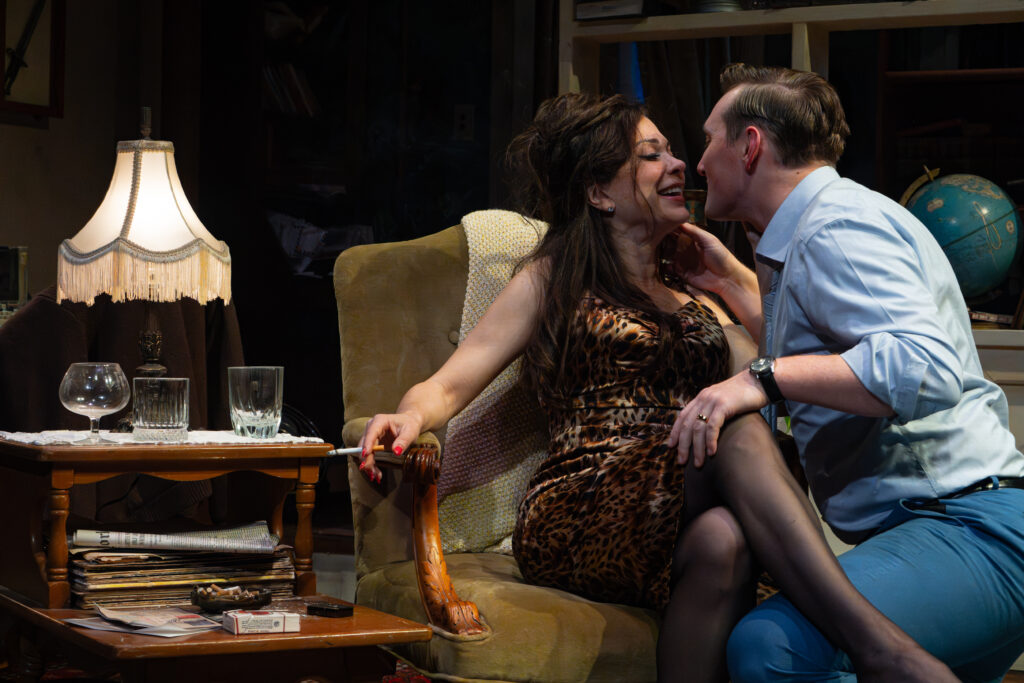
If I mentioned San Diego theatre brings an array of emotions, they are topping that with jaw-dropping set designs. Chad Ryan’s vision for Martha and George’s two-story home practically spoke on its own, with meticulous detail, including books, furniture, and knick-knacks in this broken-down brick-and-burned setting, alluding to the craziness happening and the “what a dump” line in the text. Jeffrey Neitzel’s props played another significant role in the environment, with many different-shaped glasses coming out of everywhere, accompanied by ashtrays. I felt drunk already with the urge to light up a smoke.
Chris Rynne’s lighting was a chef’s kiss, accentuating the key and crude moments, but the pass to each intermission, as well as the end, was the absolute best, adding both momentum and suspense with Evan Hart Marsh’s compositions as the soundtrack, clearly passing through Kamila Nunez’s sound.


Brenna Maienschein’s costumes not only set the stage for each character but also marked the pace as the mess grew. Nick, with a grayish baby blue fitted suit, along with Honey’s bright yellow dress and pearled headband. George, in a thick button-up sweater and pants, while Martha, who had the most outfits, started in an auburn pencil dress, swapped to an animal-print dress, and ended with a pristine all-black pant ensemble, accompanied by a lace cover and a sensual corset. (Asking for a friend, where I can get that last one in my size?)…I also loved all the hair. Martha and Honey’s half-up poofy doo, George and Nick’s clean, short cuts. The hair had its own role.
Coleman Ray Clark and Francis Gercke co-directed the piece, and I valued the space each portrayal received. Many things are happening, and the mind games are profound, so having that breath gives the opportunity to take it all in and grasp what is going on. Edward Albee’s characters are deeply layered, with complex feelings stemming from life, frustration, trauma, mental health, and infertility. Each actor conveyed those layers accordingly.
Jessica John is a powerhouse as Martha, with solid intention and good comedic timing. She owned the role, took it, and ran with it. A true masterclass. Drew Bradford had a strong BRTC debut, delivering a powerful portrayal with an array of tiers carried flawlessly. The sexual dynamic between Martha and Nick was handled with heavy but assertive doses guided by Hannah Meade’s intimacy coordination.
In my 2026 experience with ‘Virginia, I see George as the most complex of them all, and Francis Gercke nailed that complexity with a hint of kook, dry humor, and a prayer delivered in Latin during an exorcism scene to beat. Megan Carmitchel imprinted humanity and frailty on Honey. Her stage time was intermittent, yet her performance managed this tacit dialogue with the audience, making Honey easier to understand.
The curtain time was at 7:30, and it finished practically at 11…The play is three hours long with two intermissions, so brace yourself.
Adding this second experience of Who’s Afraid of Virginia Woolf? Ten years later, I can see why the Albee Estate is so guarded. Playwrights often aim to solve personal conflicts or riddles through their work. Backyard Renaissance’s production truly leaned into the psychology of this piece, coating it with its unique artistry, vision, and style. It should not be missed.
Currently playing at the Tenth Avenue Arts Theatre until March 21.
Xavier Garcia is the Stage Manager for this production, and Natalie Gelb is the Assistant Stage Manager.