

All the Men Who’ve Frightened Me dives into legacy, gender, and the weight of family, but leaves many of its most powerful ideas unspoken.
The world premiere of All the Men Who’ve Frightened Me, by Noah Diaz, came full circle in different ways: It was part of the 2021 DNA series and marked the culmination of the Playhouse’s Inaugural Director Fellowship with Kat Yen. The DNA New Work Series is a program by Artistic Director Christopher Ashley created in 2013, where playwrights and directors are invited to use the Playhouse’s rehearsal space, staff, and resources for several days (or weeks) of intensive work to develop their new project. The fellowship is a two-year, fully paid program designed to support early-career theatre professionals. So, audiences see the work practically from day one until its full-length production debut.
I always love seeing these different artists around San Diego in various theatres with their other productions. Kat Yen directed one of the first productions of this year, The Heart Sellers, at North Coast Rep. A tender story about friendship and belonging, while being new to the U.S.
All the Men Who’ve Frightened Me uses symbolism and magic realism. Set in a house that has been in one family for generations, Ty (Hennessy Winkler) and Nora (Kineta Kunutu) are a married couple setting roots in Ty’s childhood home. Nora’s womb has been diagnosed as inhospitable, Ty’s sister Carrie (Keren Lugo) is in her third trimester, and their mother (Dale Soules) cannot seem to let go of the family home, even though she wanted them to have it. Carrie and Ty’s father abandoned the family when Ty was five and his sister hadn’t been born yet. One day, during a heated argument between Nora and Ty, his dad, Henry (John Padilla) suddenly appears coming out from under the stairway. His two younger selves accompany him (Armando Riesco and Leonardo Romero). Part of the argument between the couple was how the house did not feel like “home” to Nora. So, she puts the “three dads” to work on the property. Also, Ty is a transgender man and, out of love for his wife, decides to carry their baby via in vitro.

What is happening with this story is a lot all at once. It felt like mini story lines that could each be a different play. So, in the middle, all these plots are mixed in without truly resolving any of them. Oftentimes, playwrights aim to resolve through their writing. Yet, the work brings questions that remain unanswered. There is a hint of resolution following the father’s abandonment of the family, but it is not fully realized, and it ultimately becomes another story about a broken family. Ty’s situation, being transgender and “going back” by stopping testosterone and carrying the baby, is just thrown but not explored. Like, what feelings come with that? What does that contradiction mean? And what will happen next? Both medically and after the baby. What’s mixed in is fear about parenthood and raising a child, but, as I mentioned, it’s another storyline, almost another ecosystem. I also felt that the Nora character was intentionally grayed out. An afterthought, almost. At the same time, some of the premises feel real and relatable, like Nora’s relationship with her mother-in-law and her husband’s family. The foreshadowed relationship between Carrie and her husband.
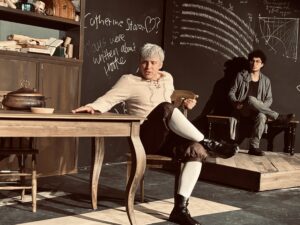
Adam Rigg’s set is a two-story home that perfectly depicts an old house lived in by one family after another, with a cool onstage dynamic where audiences can attest to the transformation, supported by Carolina Ortiz Herrera’s lighting. Lamps, like the house, are part of the play’s symbolisms.
Kat Yen’s direction is sharp as the cast is in synchrony. The trio, composed of the dads, defined each of their personalities. The sibling dynamic between Ty and Carrie is palpable, and Dale Soules as “Dale”, the mom, is definitely the star of the family. Although a considerable amount of time passes between the first time we see her and the next. Jennifer Brawn Gittings’ costumes are fun and colorful. The pre-show, intermission, and post-show playlists featured a distinctly Americana sound, keeping the audience humming, courtesy of Sound Design and Composition by UptownWorks: Daniela Hart, Noel Nichol, and Bailey Trierweiler.
As you can tell, dear reader, I have questions. Some of those questions also carry feelings. I was not alone, as you could hear flat-out conversations between audience members during the performance, and others left during intermission. That is why I consider resolution amongst these topics would benefit the play. As mentioned many times throughout this blog, theatre is a form of memory. It can also be an educational tool.
Currently playing until October 12.
The Stage Manager for this play is Heather M. Brose, with the Assistant Stage Manager: Katie Davis.





6 Responses
How were the actors performances? I saw this play. Why would people leave during intermission? The first act is incredible and doesn’t even get into any of the dads yet. Is it just because we find out Ty’s trans? It makes no sense why people would leave during intermission. The first act is wonderful. This review is kind of describing itself in terms of lacking any answers. I thought the play was incredible and I don’t think every single little thing needs to be fleshed out. It was thoroughly enjoyable, heartwarming and I didn’t mind the questions I was left with.
Thank you for commenting, Tony. We mentioned the actors’ performances in the second-to-last paragraph.
We do not know why people would leave during intermission, and it is a good question. The review mentions some of the aspects noted during the performance seen.
The beauty of art lies in how differently it touches each person and how enriching it is to have diverse opinions about the same piece. Thank you so much for reading and commenting.
We saw the play today and unfortunately agree with much of your review. The premise is distinct and fresh but we left the theater with many unanswered questions. We looked forward to the show but were disappointed in the overall story and character development. The set is incredible.
Thank you for reading and commenting, Paul. Yes, I wanted to know more about practically everything happening.
I just saw the play, and I give the actors much credit. The crafted their characters well, given the material they had to work with. But I found the material wanting. I didn’t feel a story was told, or that there was evolution of the characters.
This is a commissioned work by La Jolla Playhouse. I have see many performances there, and I think perhaps, non-commissioned works may give a better experience. It’s a difference of picking 3 plays out of 50 submitted, rather than provide money and then show whatever comes back.
Thank you for reading the review and commenting, Ethan. This work has been in The Playhouse for a while, as it originated from their DNA series. Curating a season is no easy task, and I genuinely hope that our views help this work so it reaches its full potential, allowing it to continue telling the story.