
The Roustabouts and Scripps Ranch Bring Terrence McNally’s Master Class to the Stage. A Play About Opera Sensation Maria Callas
American-born Greek opera singer Maria Callas, hailed as “La Divina” for her exceptional talent, took over headlines, hearts, and theatres during the 50s. Some say that due to her technique and overuse, her voice declined. Towards the end of 1971 and the first trimester of 1972, Callas taught a series of master classes at the Juilliard School in New York. These events served as the basis for American playwright Terrence McNally to write Master Class.
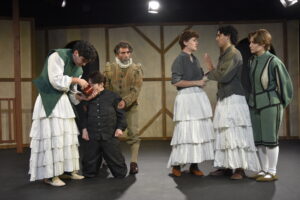
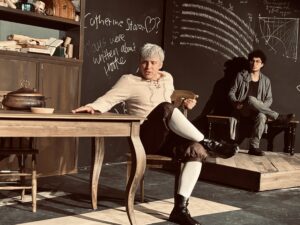
The magic of theatre comes through again in this co-production directed by Phil Johnson. It is my first time seeing this piece, and I knew that Sandy Campbell was reprising the role of Maria Callas after ten years. Well, she keeps on bringing it as we were just recovering from her Sally in Cygnet’s Follies, and now this Diva. The setting is a theatre stage or black box, courtesy of Dixon Fish’s stage design, with a pair of columns in the middle that give winks to Callas’ operatic success, Milan, and all the famous stages she graced. Different students come to workshop their talents, expecting the most productive feedback from the star. Sophie (Abigail Grace Allwein) kicks off the unique experience, bringing the material to sing Amina‘s lament from Bellini‘s opera La Sonnambula. The exchange is somewhat bizarre, in contrast to Dawn Fuller-Korinek’s costume design, which has Sophie in a hot-pink dress with gold and silver shoes. Abigail is fabulous as Sophie, showcasing a beautiful voice, excellent interpretation, and poise. A pianist is accompanying the class: Manny, played by Kyle Adam Blait, who brings great balance to the scenes. There is also a stagehand who pops in to grudgingly take care of Callas’ demands like a footstool, a cushion, and water. Blait brings the balance, and Tim Benson, the stagehand, brings the comedy as his eyerolls and long pauses had the audience in a chuckle.

Terrence McNally crafted a great story that, through fiction, captures this moment in time. During the first masterclass with Sophie, as she sings, Maria drifts into core memories she shares with the audience. It was magic, it was powerful. Ted Leib’s sound and projections helped illustrate those memories, making those scenes pop. The way Sandy shifts between the stage and the audience, semi-breaking the fourth wall, had the theatre at ease, but also holding on to their seats. Sharon (Sara Frondoni) is the next student who gets sandwiched with the tenor Anthony (Ben Read), as the nerves get the best of her, but while taking in Callas’ words during the letter scene from Verdi‘s Macbeth, the tables turn and truths are revealed. Frondoni delivered an intense portrayal with fantastic vocals and range. Ben Read, as Anthony, also delivered a tremendous voice paired with a sweet interpretation (and great hair!).
Phil’s direction featured aesthetic scenes that rose and fell in rhythm, with great gravitas. David Kievit’s lighting was playful during the light scenes that broke the fourth wall and intense during key moments in the story.
Performers are usually a double, triple, or even quadruple threat, able to dance, sing, act, and play instruments. But for this piece specifically, I loved the integration of opera singers, as it is so essential to the story and, of course, made it much more special—props to Kyle Adam Blair’s music direction.
After this play, I’m going to have to get my read on Callas and Jacqueline Kennedy Onassis because I have questions!
Master Class is currently playing until December 14. The Stage Manager is Josie Gerk.